
Why Stateless Architecture Is the Missing Backbone of Highly Available A2P Messaging
The global A2P messaging industry operates under some of the most stringent regulatory environments in telecom. Regulators and enterprises alike mandate high availability, geographic redundancy, and zero single points of failure not as best practices, but as compliance requirements.
Yet, despite these mandates, very few SMSC or SMPP platforms truly deliver stateless, distributed high availability. The reason is simple: achieving this across multiple telecom protocols and CPaaS components is architecturally complex.
Power SMPP with its strong R&D team and decades of domain expertise has built a solution, specifically to solve this challenge.
This blog explains why stateless architecture matters, why it is hard to implement in A2P messaging, and how Power SMPP delivers a production-grade solution across on-premise and cloud deployments.
1. High Availability in A2P Messaging Is Not Optional
- Regulatory non-compliance
- Financial penalties
- Broken user journeys
- Loss of enterprise trust
Most regulators explicitly require:
- No single point of failure
- Redundant network paths
- Automatic failover
- Message durability and delivery guarantees
Achieving this at scale requires architecture-level resilience, not just infrastructure redundancy.
2. What Does Stateless Architecture Mean in Messaging?
In simple terms, a stateless architecture ensures that:
- No application node holds session-critical information
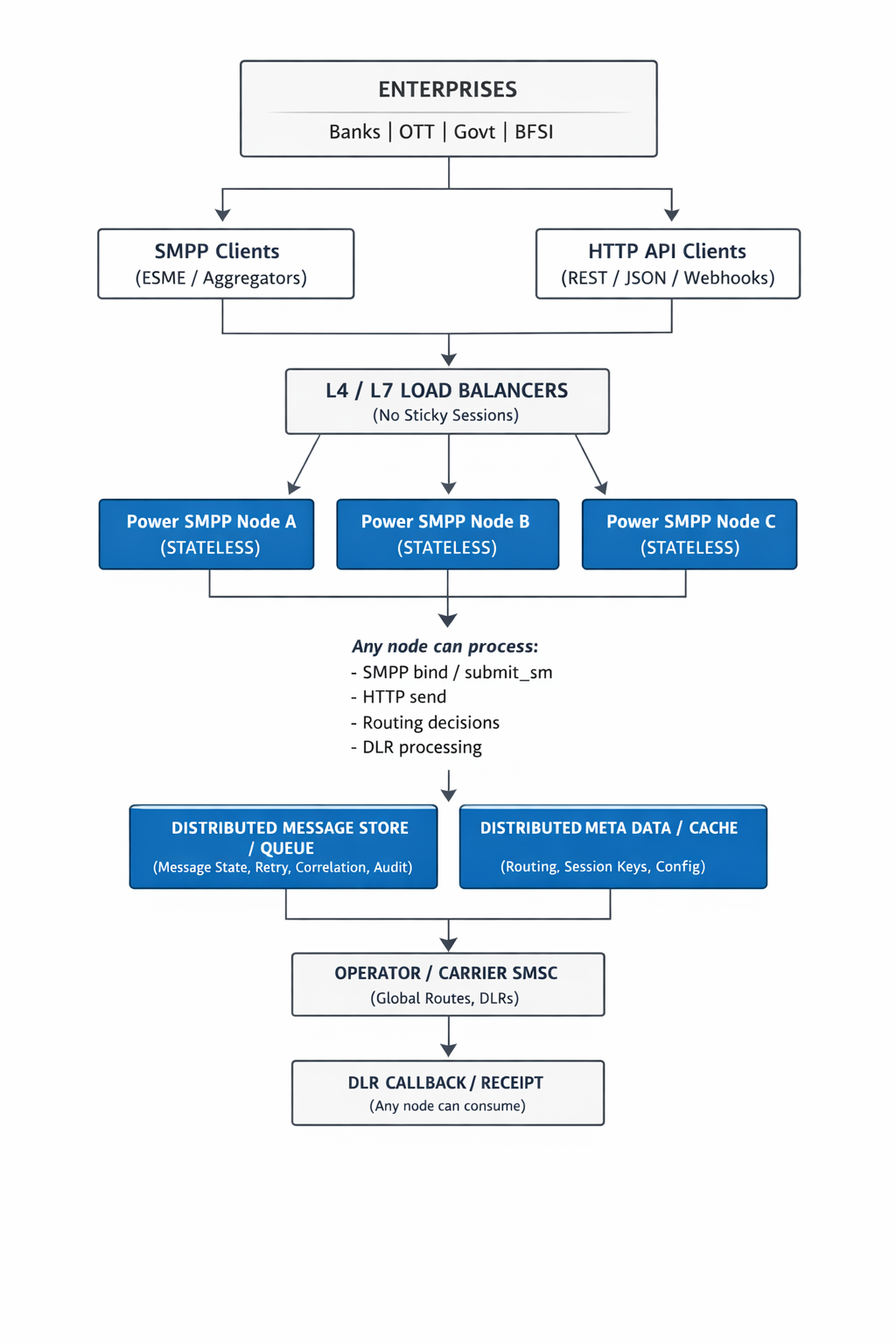
- Any request can be processed by any available node
- Node failure does not impact active traffic
- Scaling is horizontal, predictable, and fast
In a stateless messaging system:
- SMPP binds are not tied to a single node
- Message routing decisions are not locked to local memory
- Delivery receipts (DLRs) can be processed anywhere
- Failover does not require session re-hydration
This is the foundation of true high availability.
3. Why Stateless Architecture Is Extremely Hard in A2P Messaging
Unlike modern web applications, CPaaS messaging platforms deal with legacy telecom protocols, real-time delivery guarantees, and strict ordering requirements.
3.1 Protocol Diversity: SMPP vs HTTP
- HTTP APIs are naturally stateless and easier to scale
- SMPP, however, is:
- Stateful by design
- Session-oriented
- Sensitive to sequence numbers, windows, and binds
Making SMPP stateless requires:
- Decoupling session management from processing
- Synchronizing sequence state across nodes
- Handling rebinds without message loss
This is non-trivial and often avoided.
- Layer 4 (TCP) load balancers:
- Required for SMPP
- Do not understand protocol semantics
- Can break sessions if not handled carefully
- Layer 7 load balancers:
- Work well for HTTP
- Cannot interpret SMPP traffic
3.2 Load Balancers: L4 vs L7 Challenges
Designing a system that supports both protocols simultaneously, without forcing sticky sessions, is a major architectural challenge.
3.3 Database Bottlenecks and Message State
Messaging platforms require:
- Message persistence
- DLR correlation
- Retry and fallback logic
- Regulatory audit trails
Common pitfalls:
- Centralized databases becoming bottlenecks
- Synchronous writes slowing throughput
- Tight coupling between processing nodes and storage
A stateless system must:
- Separate message state from execution
- Support distributed, fault-tolerant storage
- Avoid blocking real-time traffic on database latency
3.4 DLR Handling and Routing Complexity
DLRs arrive:
- Asynchronous
- Out of order
- From multiple operator paths
In a stateful system:
- DLRs must return to the same node that sent the message
In a stateless system:
- Any node must be able to process any DLR
- Routing metadata must be globally accessible
- Failures must not impact reconciliation
This is one of the hardest problems in CPaaS architecture.
4. Why Most SMSCs Avoid True Stateless Design
Because:
- Legacy SMSCs were built for single-node or active-passive setups
- SMPP was never designed for distributed systems
- Retrofitting statelessness breaks backward compatibility
- Operational complexity increases exponentially
As a result, many platforms rely on:
- Sticky sessions
- Active-standby clusters
- Manual failover
- Hidden single points of failure
These approaches do not meet modern regulatory expectations.
5. Power SMPP: Built Stateless by Design
Power SMPP was architected from day one as a true stateless, distributed SMPP and messaging core.
Key Architectural Principles
- No session affinity
- No node-local message state
- Protocol-aware distributed processing
- Independent scaling of components
What This Enables
- Any SMPP or HTTP request can land on any node
- Nodes can be added or removed without downtime
- Traffic automatically rebalances on failure
- Message flow continues uninterrupted
6. Seamless Deployment Across On-Premise and Cloud
Power SMPP is designed for deployment flexibility, without architectural compromises.
Supported Environments
- On-premise data centers
- AWS
- Microsoft Azure
- Alibaba Cloud
Deployment Benefits
- Works behind L4 load balancers for SMPP
- Integrates cleanly with cloud-native networking
- Supports multi-AZ and multi-region setups
- Meets country-specific data residency requirements
The same stateless core runs consistently across all environments.
7. Regulatory Compliance Through Architecture, Not Workaround
With Power SMPP, high availability is not achieved through:
- Manual scripts
- Complex failover procedures
- Operator intervention
It is achieved through:
- Stateless processing
- Distributed message handling
- Built-in redundancy at every layer
This aligns directly with regulatory expectations for resilience, auditability, and continuity.
8. Conclusion: Messaging Needs a New Architectural Standard
As A2P messaging continues to power mission-critical communications, architecture becomes a compliance requirement.
Stateless, distributed design is no longer optional—it is essential.
Power SMPP represents a new generation of messaging infrastructure:
- Designed for modern CPaaS ecosystems
- Built for regulatory-grade availability
- Proven across on-premise and global cloud environments
High availability should not be a feature.
It should be the default.
 English
 Arabic
 Chinese (Simplified)
 Dutch
Dutch French
 German
 Italian
 Portuguese
 Russian
 Spanish
 Thai
Thai Vietnamese